
Green Facade Systems as a Sustainable Solution for Urban Heat Island Mitigation in Lagos State

Main Article Content
Abstract
Urban Heat Island (UHI) effects intensify heat stress, energy use, and poor air quality in rapidly urbanizing cities like Lagos. This study investigates the potential of green facades as a sustainable UHI mitigation strategy through a qualitative approach involving literature review, secondary climatic data, and comparative case studies. The analysis reveals that green facades can reduce surface temperatures by 2°C–5°C through shading and evapotranspiration, lower indoor cooling demand, and improve thermal comfort and urban air quality. Additional benefits include biodiversity enhancement and energy efficiency. However, challenges such as high installation costs, plant maintenance, and limited technical expertise may hinder adoption. Opportunities lie in Lagos' evolving sustainability agenda, policy frameworks, and private-sector involvement. The study recommends integrating green facades into building codes, providing economic incentives, and promoting multi-stakeholder collaboration for maintenance. This research positions green facades as a feasible climate-adaptive solution for UHI mitigation and sustainable urban development in tropical environments like Lagos.
Article Details
Copyright (c) 2025 Tolulope A. Afolabi, Obafemi Adeniyi Ibitoye, Kalu C. Grace, Gabriel Olaoye (Author)

This work is licensed under a Creative Commons Attribution 4.0 International License.
Tolulope A. Afolabi, Caleb University, Imota, Lagos State, Nigeria.
Department of Architecture, College of Postgraduate Studies,
Caleb University, Imota, Lagos State, Nigeria.
Obafemi Adeniyi Ibitoye, Caleb University, Imota, Lagos State, Nigeria.
Department of Architecture, College of Postgraduate Studies,
Caleb University, Imota, Lagos State, Nigeria.
Kalu C. Grace, Caleb University, Imota, Lagos State, Nigeria.
Department of Architecture, College of Postgraduate Studies,
Caleb University, Imota, Lagos State, Nigeria.
Gabriel Olaoye, Caleb University, Imota, Lagos State, Nigeria.
Department of Architecture, College of Postgraduate Studies,
Caleb University, Imota, Lagos State, Nigeria.
(2025). Wikimedia.org. https://upload.wikimedia.org/wikipedia/commons/thumb/a/aa/%281%29Central_building_Broadway_Sydney-1.jpg/330px-%281%29Central_building_Broadway_Sydney-1.jpg

Anthony Adenaike, F., Pearl Opoko, A., & Abidemi Kosoko, R. (2020). Physical Planning Policies on Lagos Island and Their Effects on Urban Morphology. Urban and Regional Planning, 5(2), 50. https://doi.org/10.11648/j.urp.20200502.13 DOI: https://doi.org/10.11648/j.urp.20200502.13
Arunab, K. S., & Mathew, A. (2024). Quantifying urban heat island and pollutant nexus: A novel geospatial approach. Sustainable Cities and Society, 101, 105117. https://doi.org/10.1016/j.scs.2023.105117 DOI: https://doi.org/10.1016/j.scs.2023.105117
Aung, T., Bhaumik, A., Htet, A., & Liana, S. R. (2023). Implementing green facades: A step towards sustainable smart buildings. Journal of Smart Cities and Society, 2. https://doi.org/10.3233/scs-230014 DOI: https://doi.org/10.3233/SCS-230014
Austin, S. (2022, August 26). Hotel Review: Oasia Hotel Downtown, Singapore. The Travel Magazine. https://www.thetravelmagazine.net/hotel-review-oasia-hotel-singapore-downtown/
Ayanlade, A., Aigbiremolen, M. I., & Oladosu, O. R. (2021). Variations in urban land surface temperature intensity over four cities in different ecological zones. Scientific Reports, 11(1), 20537. https://doi.org/10.1038/s41598-021-99693-z DOI: https://doi.org/10.1038/s41598-021-99693-z
Bassett, R., Young, P. J., Blair, G. S., Samreen, F., & Simm, A. W. (2020). The Megacity Lagos and Three Decades of Urban Heat Island Growth. https://doi.org/10.1175/JAMC-D-20
Bassett, R., Young, P. J., Blair, G. S., Samreen, F., & Simm, W. (2020). The Megacity Lagos and Three Decades of Urban Heat Island Growth. Journal of Applied Meteorology and Climatology, 59(12), 2041–2055. https://doi.org/10.1175/jamc-d-20-0059.1 DOI: https://doi.org/10.1175/JAMC-D-20-0059.1
Benjamin Obe, O., Eniolu Morakinyo, T., & Mills, G. (2024). An assessment of WRF-urban schemes in simulating local meteorology for heat stress analysis in a tropical sub-Saharan African city, Lagos, Nigeria. International Journal of Biometeorology, 68(5), 811–828. https://doi.org/10.1007/s00484-024-02627-3
Blanco, I., Schettini, E., Mugnozza, G. S., & Vox, G. (2020). Thermal behaviour of green façades in summer. Journal of Agricultural Engineering, 49(3), 183–190. https://doi.org/10.4081/jae.2018.835 DOI: https://doi.org/10.4081/jae.2018.835
Climate Chip. (2024). Your Area: Today (switch to: Tomorrow or WorkHeat) | Climate CHIP. Climatechip.org. https://www.climatechip.org/your-area-climate-data
Faremi, O. J., Ajayi, O. O., Zakariyyah, K. I., & Adenuga, O. A. (2021). Climatic conditions and the resilience of buildings along Lagos coastline. Built Environment Project and Asset Management, 11(4), 738–749. https://doi.org/10.1108/BEPAM-03-2020-0055 DOI: https://doi.org/10.1108/BEPAM-03-2020-0055
Fleck, R., Gill, R. L., Saadeh, S., Pettit, T., Wooster, E., Torpy, F., & Irga, P. (2022). Urban green roofs to manage rooftop microclimates: A case study from Sydney, Australia. Building and Environment, 209, 108673. https://doi.org/10.1016/j.buildenv.2021.108673 DOI: https://doi.org/10.1016/j.buildenv.2021.108673
Global Surface UHI Explorer. (2025). Global_Surface_UHI_Explorer. Yceo.users.earthengine.app. https://yceo.users.earthengine.app/view/uhimap
Gonzalez-Trevizo, M. E., Martinez-Torres, K. E., Armendariz-Lopez, J. F., Santamouris, M., Bojorquez-Morales, G., & Luna-Leon, A. (2021). Research trends on environmental, energy and vulnerability impacts of Urban Heat Islands: An overview. Energy and Buildings, 246, 111051. https://doi.org/10.1016/j.enbuild.2021.111051 DOI: https://doi.org/10.1016/j.enbuild.2021.111051
H. C. O. Unegbu, Yawas, D. S., B. Dan-asabe, & Alabi, A. A. (2024). Evaluating the Effectiveness of Green Roofs and Walls in Nigeria’s Urban Centers. https://doi.org/10.21203/rs.3.rs-4586270/v1 DOI: https://doi.org/10.21203/rs.3.rs-4586270/v1
Hajer Khaled Jabbar, Hamoodi, M. N., & Al-Hameedawi, A. N. (2023). Urban heat islands: a review of contributing factors, effects and data. IOP Conference Series, 1129(1), 012038–012038. https://doi.org/10.1088/1755-1315/1129/1/012038 DOI: https://doi.org/10.1088/1755-1315/1129/1/012038
Hian, S., Chan, M., Qiu, L., Esposito, G., & Mai, K. P. (2021). Vertical greenery buffers against stress: Evidence from psychophysiological responses in virtual reality. DOI: https://doi.org/10.1016/j.landurbplan.2021.104127
Htet, A., Liana, S. R., Aung, T., & Bhaumik, A. (2023). Economic and Environmental Impact Analysis of Green Building Materials in Facade Engineering. In International Journal of Membrane Science and Technology (Vol. 10, Issue 2). DOI: https://doi.org/10.15379/ijmst.v10i2.2973
Isunju, J. B., Ssekamatte, T., Wanyenze, R., Mselle, J. S., Wafula, S. T., Kansiime, W. K., Bateganya, N. L., Nalugya, A., Wagaba, B., Denny, L., McGriff, J. A., Wang, Y., Yakubu, H., & Mugambe, R. K. (2022). Analysis of management systems for sustainability of infection prevention and control, and water sanitation and hygiene in healthcare facilities in the Greater Kampala Area, Uganda. PLOS Water, 1(5), e0000021. https://doi.org/10.1371/journal.pwat.0000021 DOI: https://doi.org/10.1371/journal.pwat.0000021
Irfeey, A. M. M., Chau, H. W., Sumaiya, M. M. F., Wai, C. Y., Muttil, N., & Jamei, E. (2023). Sustainable Mitigation Strategies for Urban Heat Island Effects in Urban Areas. Sustainability (Switzerland), 15(14). https://doi.org/10.3390/su151410767 DOI: https://doi.org/10.3390/su151410767
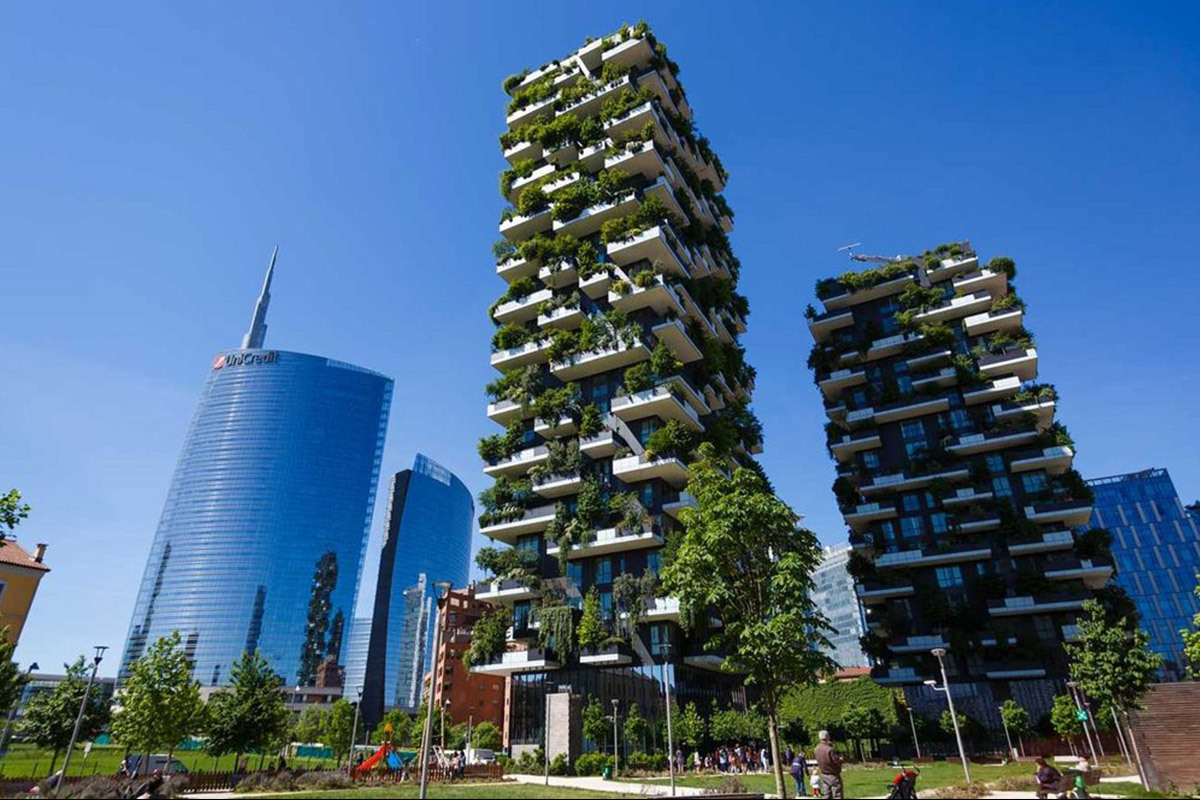
Ivica, E. (2024). Pedestal-Eternoivica.com. https://www.pedestal-eternoivica.com/uploads/images/posts/1887/col12_bosco-verticale-a0941311763418c605b94e7d708c3752.jpg
K Benhalilou, Saliha Abdou, & Rabah Djedjig. (2020). EXPERIMENTAL INVESTIGATION OF HYGROTHERMAL BEHAVIOR OF DIRECT GREEN FACADES UNDER SEMI-ARID CLIMATE. Journal of Fundamental and Applied Sciences, 12. https://doi.org/10.4314/jfas.v12i1.15
Kim, S. W., & Brown, R. D. (2021). Urban heat island (UHI) intensity and magnitude estimations: A systematic literature review. Science of the Total Environment, 779, 146389. https://doi.org/10.1016/j.scitotenv.2021.146389 DOI: https://doi.org/10.1016/j.scitotenv.2021.146389
Kozamernik, J., Rakuša, M., & Nikšic, M. (2020). How green facades affect the perception of urban ambiences: Comparing Slovenia and the Netherlands. Urbani Izziv, 31(2), 88–100. https://doi.org/10.5379/urbani-izziv-en-2020-31-02-003 DOI: https://doi.org/10.5379/urbani-izziv-en-2020-31-02-003
Liang, Z., Huang, J., Wang, Y., Wei, F., Wu, S., Jiang, H., Zhang, X., & Li, S. (2021). The mediating effect of air pollution in the impacts of urban form on nighttime urban heat island intensity. Sustainable Cities and Society, 74, 102985. https://doi.org/10.1016/j.scs.2021.102985 DOI: https://doi.org/10.1016/j.scs.2021.102985
Moreira-Zambrano, V. A., & Moreno-Rangel, D. (2020). Green faÇades: Benefits, indicators and design parameters. WIT Transactions on the Built Environment, 195, 137–148. https://doi.org/10.2495/ARC200111 DOI: https://doi.org/10.2495/ARC200111
Myers, J. (2022, May 6). These are Africa’s fastest-growing cities. World Economic Forum. https://www.weforum.org/stories/2016/05/these-are-africa-s-fastest-growing-cities/
Obe, O. B., Morakinyo, T. E., & Mills, G. (2024). An assessment of WRF-urban schemes in simulating local meteorology for heat stress analysis in a tropical sub-Saharan African city, Lagos, Nigeria. International Journal of Biometeorology, 68(5), 811–828. https://doi.org/10.1007/s00484-024-02627-3 DOI: https://doi.org/10.1007/s00484-024-02627-3
Obiefuna, J. N., Okolie, C. J., Nwilo, P. C., Daramola, O. E., & Isiofia, L. C. (2021). Potential Influence of Urban Sprawl and Changing Land Surface Temperature on Outdoor Thermal Comfort in Lagos State, Nigeria. Quaestiones Geographicae, 40(1), 5–23. https://doi.org/10.2478/quageo-2021-0001 DOI: https://doi.org/10.2478/quageo-2021-0001
Okwandu, A. C., & Nwokediegwu, P. (2024). Green architecture: Conceptualizing vertical greenery in urban design. Engineering Science & Technology Journal, 5, 1657–1677. https://doi.org/10.51594/estj/v5i5.1114 DOI: https://doi.org/10.51594/estj.v5i5.1114
Oni, F., & Ibeabuchi, U. (2023). Mapping Urban Heat Island Areas in Ibadan. JMSS) A2Z Journalsnal of Management and Service Science (JMSS), 03(025), 1–15. https://doi.org/10.54060/jmss.2023 DOI: https://doi.org/10.54060/jmss.2023.25
Oyewo, O. (2023). POPULATION GROWTH AND ECONOMIC WELLBEING IN LAGOS, NIGERIA. Nigerian Journal of Horticultural Science, 27(2). https://hortson.org.ng/images/Journals/2023volume/Oyewo_and_Oyewale_2023_compressed.pdf
Pacini, A., Edelmann, H. G., Großschedl, J., & Schlüter, K. (2022). A Literature Review on Facade Greening: How Research Findings May Be Used to Promote Sustainability and Climate Literacy in School. In Sustainability (Switzerland) (Vol. 14, Issue 8). MDPI. https://doi.org/10.3390/su14084596 DOI: https://doi.org/10.3390/su14084596
Perini, K., Magrassi, F., Giachetta, A., Moreschi, L., Gallo, M., & Del Borghi, A. (2021). Environmental sustainability of building retrofit through vertical greening systems: A life-cycle approach. Sustainability (Switzerland), 13(9). https://doi.org/10.3390/su13094886 DOI: https://doi.org/10.3390/su13094886
Popoola, O., Monica, B., Bashorun, A., Olalere, P., & Akande, S. (2022). Green Infrastructure Measures to Mitigate the Urban Heat Island of Ibeju Lekki, Lagos, Nigeria. Ecocity World Summit 2021-22 Conference Proceedings. https://www.researchgate.net/publication/371939017_Green_Infrastructure_Measures_to_Mitigate_the_Urban_Heat_Island_of_Ibeju_Lekki_Lagos_Nigeria
Sayad, B., Mansour Rifaat Helmi, Oumr Adnan Osra, Ahmad Mohammed Abed, & Haytham Hussain Alhubashi. (2024). Microscale Investigation of Urban Heat Island (UHI) in Annaba City: Unveiling Factors and Mitigation Strategies. Sustainability, 16(2), 747–747. https://doi.org/10.3390/su16020747 DOI: https://doi.org/10.3390/su16020747
Sayigh Ali, & Antonella Trombadore. (2022). The Importance of Greenery in Sustainable Buildings. http://www.springer.com/series/15925 DOI: https://doi.org/10.1007/978-3-030-68556-0
Singh, H., Banerjee, Dr. S., & Tripathi, Ar. A. (2024). BIOPHILIC DESIGN IN HIGH RISE BUILDINGS. International Research Journal of Modernization in Engineering Technology and Science. https://doi.org/10.56726/irjmets59159 DOI: https://doi.org/10.56726/IRJMETS59159
Teo, Y. H., Makani, M. A. B. H., Wang, W., Liu, L., Yap, J. H., & Cheong, K. H. (2022). Urban Heat Island Mitigation: GIS-Based Analysis for a Tropical City Singapore. International Journal of Environmental Research and Public Health, 19(19). https://doi.org/10.3390/ijerph191911917 DOI: https://doi.org/10.3390/ijerph191911917
Umunna, C. (2024). PATHWAYS TOWARDS SUSTAINABLE DEVELOPMENT: Environmental diagnostics and air pollution mitigation in Lagos, Nigeria. Gupea.ub.gu.se. https://hdl.handle.net/2077/80831
UN-HABITAT. (2023). UNITED NATIONS HUMAN SETTLEMENT PROGRAMME (UN-HABITAT) ANNUAL REPORT 2022. https://unhabitat.org/sites/default/files/2023/06/unhabitat_annualreport_2022.pdf
Wonorahardjo, S., Sutjahja, I. M., Mardiyati, Y., Andoni, H., Achsani, R. A., Steven, S., Thomas, D., Tunçbilek, E., Arıcı, M., Rahmah, N., & Tedja, S. (2022). Effect of different building façade systems on thermal comfort and urban heat island phenomenon: An experimental analysis. Building and Environment, 217, 109063. https://doi.org/10.1016/j.buildenv.2022.109063 DOI: https://doi.org/10.1016/j.buildenv.2022.109063
World Bank Group. (2021). ANNUAL REPORT 2021 (ENGLISH SUMMARY). https://thedocs.worldbank.org/en/doc/cd05d27f0203b90751fcfe7145cd5a3d-0330122021/original/EDS05-Annual-Report-2021-English-Summary.pdf
Yadav, A., & Singh, J. (2024). A Study on Urban Heat Island (UHI): Challenges and Opportunities for Mitigation. Current World Environment, 19(1), 436–453. https://doi.org/10.12944/cwe.19.1.37 DOI: https://doi.org/10.12944/CWE.19.1.37
Yadav, N., Rajendra, K., Awasthi, A., Singh, C., & Bhushan, B. (2023). Systematic exploration of heat wave impact on mortality and urban heat island: A review from 2000 to 2022. Urban Climate, 51, 101622. https://doi.org/10.1016/j.uclim.2023.101622 DOI: https://doi.org/10.1016/j.uclim.2023.101622
Article Sidebar
